Autumn Thread Colors for Cross Stitch and Needlepoint: DMC Numbers and Wool Palettes
September 19, 2026
Five hundred DMC shades, a conversion chart that cross-references half of them, and a photo converter that generates a palette of twenty-three very-similar warm tones; thread selection can feel like the hardest part of planning an autumn piece. It doesn't have to be.
This guide covers the autumn color families in DMC that experienced stitchers reach for again and again, the temperature principle that keeps fall palettes feeling unified, the two or three variegated threads worth keeping in your autumn kit, how cotton and tapestry wool differ for seasonal canvaswork, and what to do when a photo conversion delivers a pile of near-identical orange and brown shades.
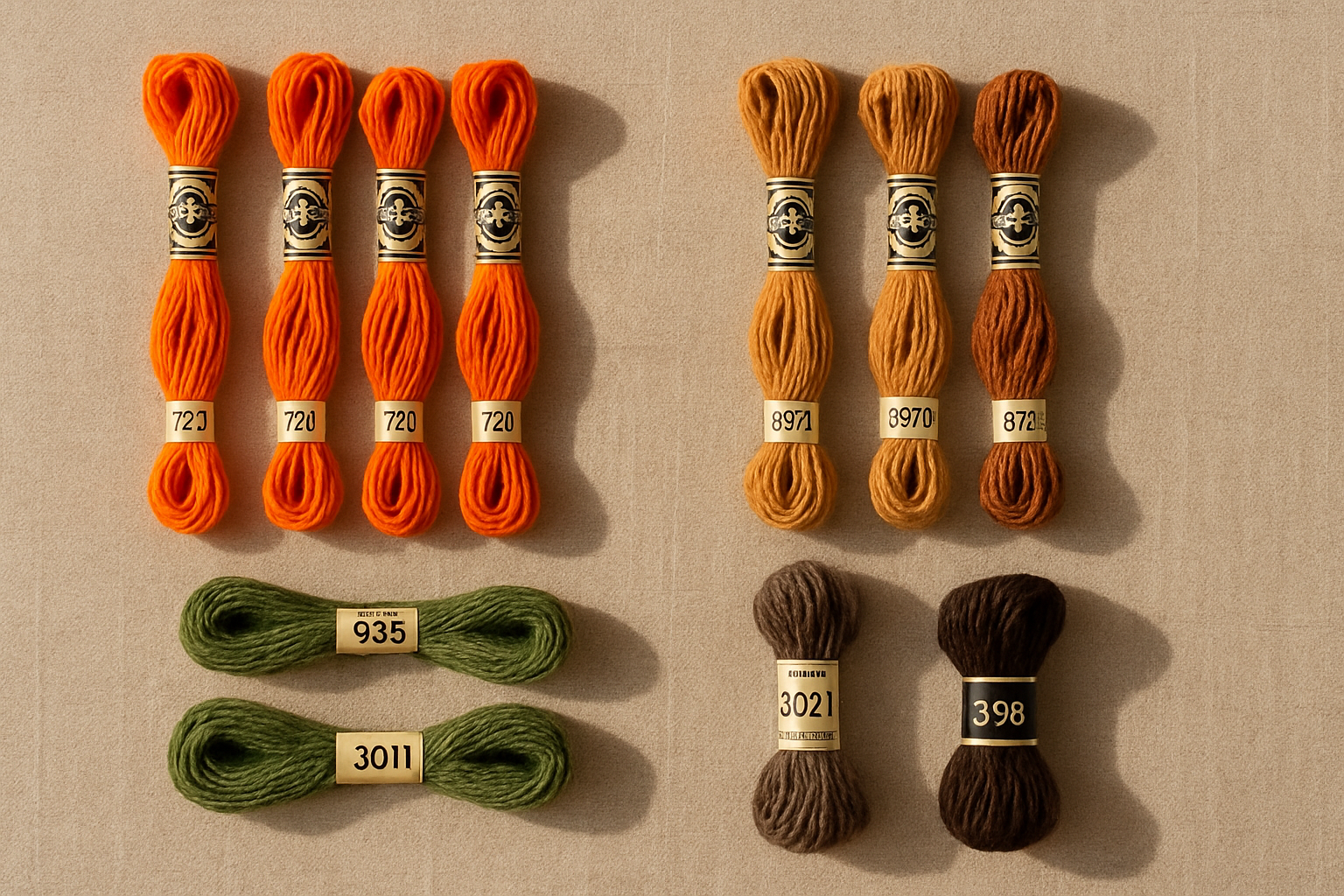
The Autumn Color Families in DMC
DMC's numbering system is meaningful: shades close in number are close in color, so near numbers are light-to-dark steps within the same family. Knowing the autumn families lets you navigate the catalogue without consulting a chart from scratch every time.
The Orange Spice family: 722 → 721 → 720
These three shades (Light, Medium, and Dark Orange Spice) are the backbone of any pumpkin, autumn leaf, or harvest palette. DMC 720 is the deep burnt orange of a ripe field pumpkin; 721 is the mid-tone lit side; 722 is the pale cream-orange highlight. Use all three for modelled pumpkins with depth. Use 720 alone as a bold accent against neutral backgrounds.
The Golden Brown family: 3827 → 3826 → 975
3827 (Pale Golden Brown) through 3826 (Golden Brown) to 975 (Dark Golden Brown) provides the warm mid-register that autumn needs alongside orange. These are bark colors, acorn cap colors, the shadowed side of dried grass. 3826 is the most versatile of the three; it bridges orange and deep brown without dominating either.
The Hazel and Drab range: 422 → 420 → 869
422 (Light Hazel) and its darker steps read as pale wood, dry wheat, and the underside of autumn leaves. These are the tones that keep a warm palette from feeling heavy. A splash of 422 in an otherwise saturated autumn piece is what makes it breathe.
The Autumn Green anchors: 3013 → 937 → 936
Not all autumn greens are cool. DMC 936 (Very Dark Avocado Green) and 937 (Medium Avocado Green) are warm greens (they contain yellow), so they sit naturally alongside oranges and golds. These are the greens for shadowed leaves, vine shadows, and stems. 3011 (Dark Khaki Green) is another warm option, useful for dried or fading foliage.
The Grounders: 3021 → 838 → 3371
Every warm palette needs a near-black that doesn't read as cold. DMC 3021 (Very Dark Brown Grey) is warm-toned and works as the outline, bare branch, and deep shadow shade. 838 (Very Dark Beige Brown) and 3371 (Black Brown) are its darker cousins. Avoid true black (310) in autumn work; it reads as cold and modern in a warm seasonal palette, and the contrast is too sharp.
Color Temperature: The Most Common Autumn Palette Mistake
The most useful concept for building a fall thread palette is color temperature, and the most common mistake is mixing warm and cool tones without realizing it.
Warm colors — yellows, oranges, warm reds, warm browns, olive greens — advance visually and read as lit, close, and energetic. Cool colors (blues, blue-greens, cool greys, cool purples) recede and read as shadowed, distant, and calm. Autumn is defined by warm tones, and a palette stays coherent when its neutrals and shadows are warm too.
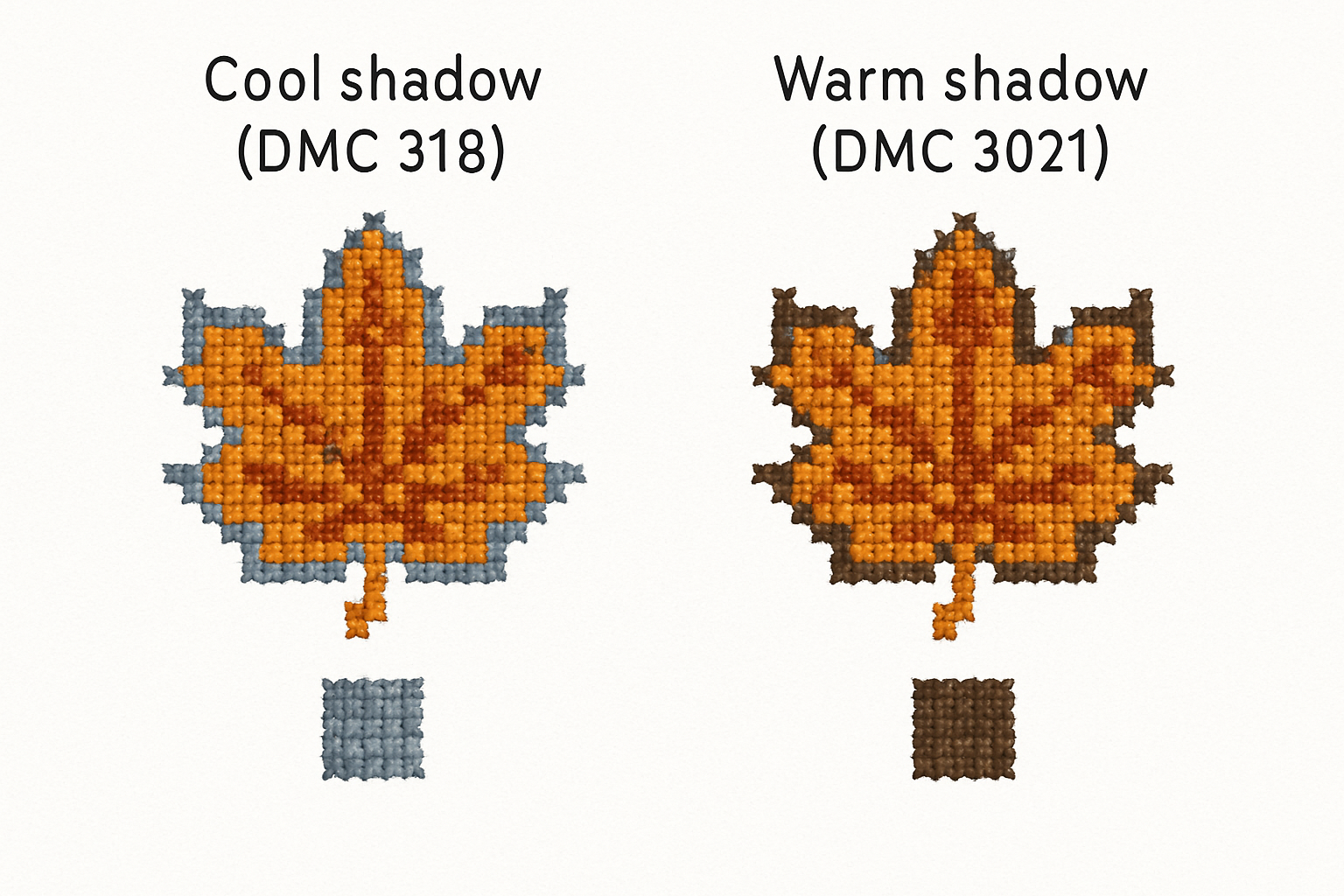
The specific mistake: choosing a cool mid-grey (such as DMC 318 or 415) as a shadow tone in an autumn piece because it seems "neutral." It isn't neutral in context; it pulls the eye out of the warm register. The fix is to reach for DMC 3021 or 640 (Very Dark and Dark Beige Grey) instead, both of which are warm-toned near-neutrals that shadow without clashing.
A quick test when you're unsure: hold the candidate shadow shade next to your lightest orange (722 or 3827). If the grey looks distinctly blue or purple by comparison, it's too cool. If it reads as a darker version of the same warmth, it belongs.
DMC Color Variations: When Variegated Thread Earns Its Place
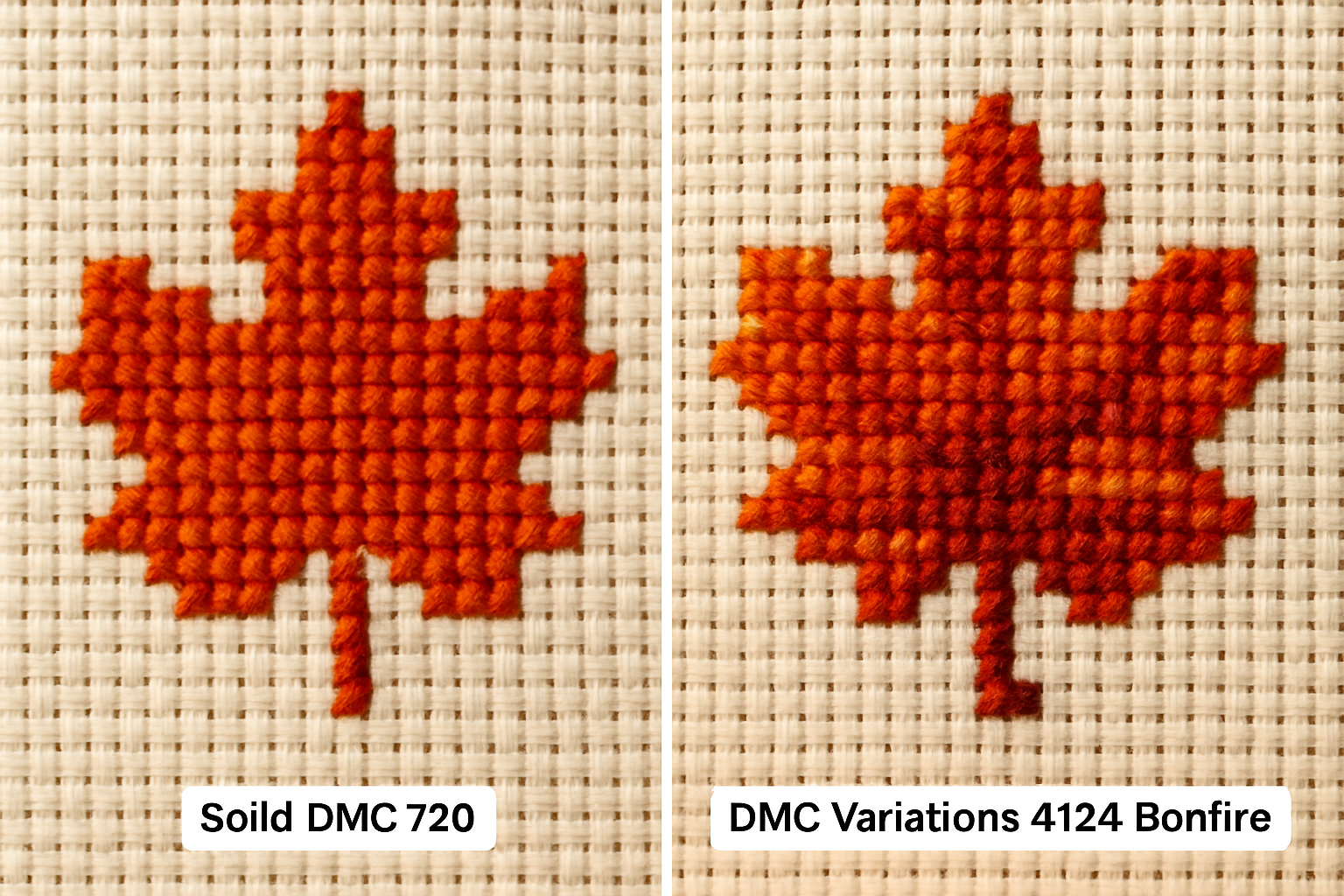
DMC Color Variations are multicolored flosses that shift through a gradient within a single skein. Four of them are particularly well-suited to autumn work:
4122 — Fall Harvest: Shifts through deep reds, burnt oranges, and warm golds. Excellent for autumn foliage areas, borders, and scatter-motif backgrounds where you want color variation without constant thread changes.
4124 — Bonfire: Moves from amber through deep orange to red-brown. Works especially well for a single-color pumpkin that needs dimension without dedicated highlight and shadow shades; the color shift gives natural modelling on small motifs.
4126 — Desert Canyon: Terracotta through warm dusty rose to cream. More muted than the above two, good for dried grasses, seedheads, and autumn still-life work where you want warmth without full orange saturation.
4120 — Tropical Sunset: Warm coral through orange, brighter and more graphic than Desert Canyon. Good as a single accent in an otherwise earthy palette.
Variegated thread works well for background areas, borders, foliage fills, and geometric patterns. It's a poor choice for focal areas (faces, eyes, specific subjects) where the unpredictable color position undermines legibility. For photo-based patterns specifically, use solid DMC for every area the converter has defined; variegated threads are best reserved for borders and finishing touches added after the main pattern is complete.
One technique note: when stitching DMC Color Variations, complete each cross fully before moving to the next stitch rather than stitching a row of half-stitches first. This gives smooth color transitions rather than striped or pooled effects.
Cotton or Tapestry Wool? Choosing Your Thread Format
The fiber choice affects how autumn colors read as much as the specific shades.
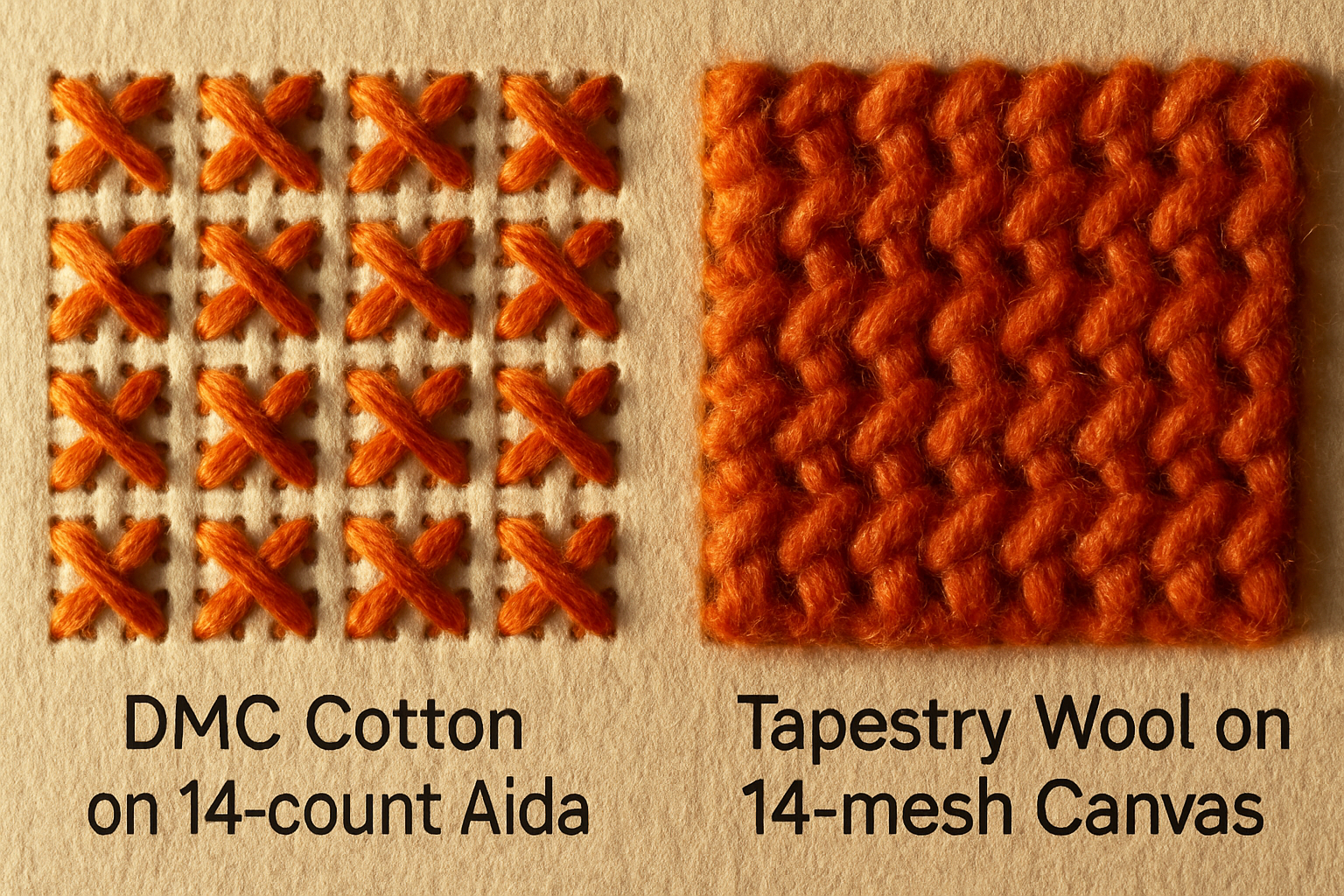
DMC six-strand cotton (stranded mouliné) is the standard for cross stitch on Aida and evenweave. It has a smooth, slightly lustrous, matte surface. Colors are accurate but slightly muted; the flat sheen keeps even vivid oranges feeling controlled and refined. It's the right choice for framed work, samplers, and any piece where you want the characteristic X-grid of counted cross stitch to show.
DMC Tapestry Wool (Colbert, 486 shades) is a single-strand 4-ply wool designed for needlepoint and canvaswork on mono canvas. Wool has a natural, slightly nubby texture that makes colors look richer and more saturated than cotton at the same shade number. A needlepoint pumpkin in DMC Colbert 7918 (the wool equivalent of burnt orange) has a warmth and textile density that cotton on Aida doesn't. Wool is also considerably more durable for functional objects: pillows, ornaments, and anything that will be handled.
Anchor Tapestry Wool (475 shades, 4-ply, colorfast) is the standard alternative to DMC Colbert and is widely used in the UK. The color range and weight are similar; conversion charts exist for DMC-to-Anchor cross-referencing, though they're approximate rather than exact. When building an autumn palette in wool, stick to one brand throughout; mixing wool brands in a single piece creates coverage inconsistencies.
Strand counts for Aida and canvas:
| Fabric | Count | Strands |
|---|---|---|
| Aida (cross stitch) | 11-count | 3 strands |
| Aida (cross stitch) | 14-count | 2 strands |
| Aida (cross stitch) | 16-count | 2 strands |
| Aida (cross stitch) | 18-count | 1–2 strands |
| Mono canvas (needlepoint) | 12-mesh | 1 strand tapestry wool |
| Mono canvas (needlepoint) | 14-mesh | 1 strand tapestry wool or 3 strands cotton |
| Mono canvas (needlepoint) | 18-mesh | 1 strand cotton or Persian wool |
When a Photo Generates the Autumn Palette for You
If you're using a photo converter to build your pattern, the algorithm handles the DMC matching, but understanding what it's doing helps you interpret and improve the result.
The converter quantizes your image (reduces millions of RGB values to N colors) and then matches each resulting color to its closest DMC shade using a Delta E calculation, which measures perceptual color distance. For autumn subjects this creates a predictable pattern: near-duplicate warm shades.
A real autumn photo contains thousands of slightly different orange-gold-brown values. The converter maps clusters of these to the closest DMC neighbors, and in the orange-brown range of DMC, those closest neighbors are often DMC 720, 721, and 722 (the Orange Spice family), or 3826, 3827, and 3828. The resulting palette can include all three, even though in the hoop two of them are nearly indistinguishable.
This is normal. It doesn't mean the conversion failed. It means your palette contains redundancy worth consolidating:
- After generating your preview, look at the color palette panel and identify any shades that look nearly identical to each other.
- In the digital canvas, use the color swap tool to replace the lighter duplicate with the darker one everywhere it appears (or vice versa; try both and compare).
- This typically reduces your thread count by two to four shades on an autumn subject without any visible change to the finished pattern.

Knowing which DMC numbers to reach for, which temperature to keep warm throughout, and where photo conversions naturally generate redundancy puts you in control of the palette before you pull a single skein from the drawer. That control is the difference between an autumn piece that feels unified and one that just feels brown.
Try it with your own photo
Upload a photo and see your counted cross stitch pattern preview — free, before you pay anything.
Try the free pattern previewA little autumn gift for reading this far
Start your fall pattern free, then use one of these codes at checkout when you unlock the digital canvas.
Codes valid through the end of autumn 2026.