Halloween Cross Stitch and Needlepoint Patterns from Photos: Pets, Pumpkins, and the Spooky Palette
September 19, 2026
Halloween has something the rest of autumn doesn't: a visual vocabulary that cross stitch renders exceptionally well. Jack-o-lanterns, black cats, bare branches, a full moon, cobwebs: high-contrast subjects on dark backgrounds, bold graphic shapes, a color scheme where the thread choices are unmistakable. The Just Cross Stitch Halloween magazine has been running for decades. Designers release limited-window Halloween collections that sell out. Pinterest boards with "Halloween cross stitch" run into the hundreds of thousands of pins.
And increasingly, the most personal Halloween pieces come from photos: your own cat in a witch hat, the pumpkins on your porch, a candlelit still life you want to stitch before the season disappears. This guide covers the Halloween aesthetic in cross stitch and needlepoint, how to turn Halloween photos into counted patterns, the DMC palette that makes a spooky piece feel genuinely spooky, and the dark fabric options worth knowing about.
The Halloween Aesthetic in 2026: What's Getting Stitched
Halloween cross stitch has developed a distinct look that goes well beyond orange pumpkins on white Aida. A few design directions have taken hold:
Witchy and dark apothecary. Potion bottles, spell books, mortar and pestle, moon phases, botanical skulls. Designers like The Witchy Stitcher have built substantial followings around this aesthetic, which blends craft nostalgia with gothic sensibility. It reads as moody and atmospheric rather than cute, and it tends to look good year-round rather than just in October.
"Ghostly grandma core." The term emerged in 2025 and has stuck: vintage-adjacent, slightly absurdist Halloween design: grandmotherly domestic scenes with ghosts in them, cross stitch samplers that look like something your grandmother might have made, but for a haunted house. Cozy and spooky at the same time. This is the aesthetic that makes people say "I need this on my wall all year."
Silhouette and graphic minimalism. A black cat sitting in a full orange moon. A haunted house against a dark sky. A single candle in a dark frame. High contrast, few colors, instantly readable. These designs suit dark fabric particularly well and are genuinely beginner-friendly despite their visual impact.
Photo-based Halloween pieces. Your specific cat in her actual witch hat. The jack-o-lantern you carved this year. The porch scene from last October. These are the pieces that come out every year and mean something increasingly specific over time.
Turning Halloween Photos into Cross Stitch and Needlepoint Patterns
Halloween presents specific photo-to-pattern opportunities and specific challenges. Here's what works:
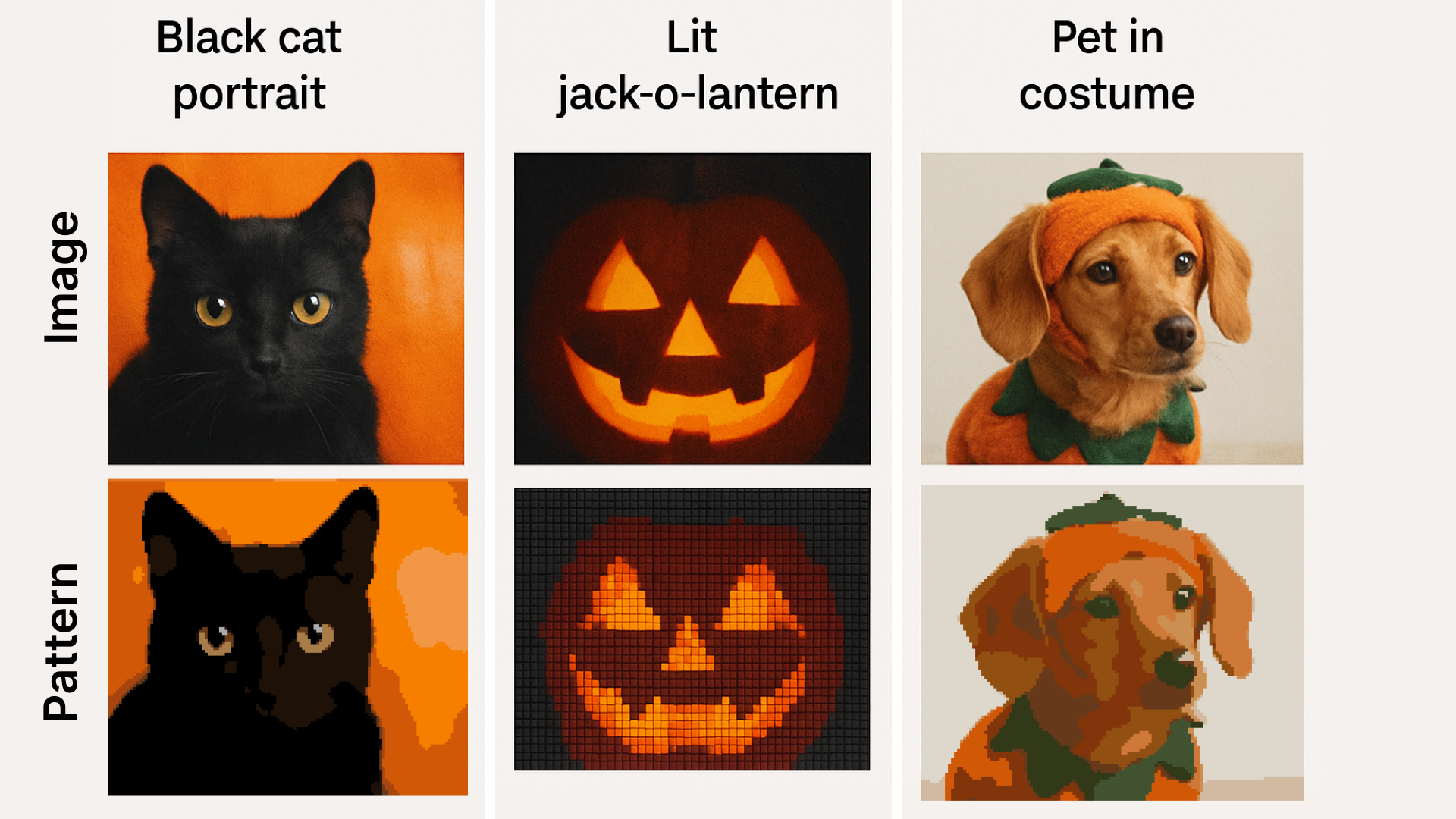
Your black cat against a light background is one of the most striking Halloween conversion subjects when the photo is set up correctly. The critical word is "against." A black cat on a dark sofa or in a dim room gives a converter nothing to work with — the subject and background are the same near-black, and the result is a pattern that reads as a dark smudge. Photograph your black cat against a pale wall, a white sheet, bright autumn leaves, or an orange pumpkin. The contrast does the work. At 15–25 colors, a well-photographed black cat with visible fur texture and clear catchlights in the eyes converts into something genuinely dramatic.
A close-up of a carved jack-o-lantern, lit from inside, is a surprisingly excellent conversion subject. The glowing orange interior against the dark carved edges creates exactly the high-contrast structure a converter needs. Shoot in a darkened room, let the candle or LED provide the light, and crop to fill the frame with the face. The resulting palette (deep warm orange, charcoal grey, near-black) produces a pattern that looks intentionally designed.
Your pet in a Halloween costume works when the costume provides contrast and is photographed in good light. The most successful costume photos for conversion: bright or warm-toned costumes against neutral backgrounds, eye-level shots where the face fills most of the frame, and natural or window light rather than flash. Flash creates harsh shadows and red-eye that a converter can't ignore.
Halloween still lifes (a cluster of carved pumpkins on a porch, a windowsill of candles and gourds, a bowl of mixed autumn gourds) convert well because the subject matter is already bold, graphic, and warm. Remove any busy or distracting background and crop tight to the arrangement.
What to avoid: dark subject against dark background (insufficient contrast), motion-blurred action shots, extreme close-ups with no compositional context, and dimly lit indoor scenes with mixed artificial light sources that give the converter no clear color regions.
The Halloween DMC Thread Palette
Halloween has its own color logic, distinct from the warm golden palette of the rest of autumn. Where fall is about richness and warmth, Halloween is about contrast: vivid saturated colors against deep darks.
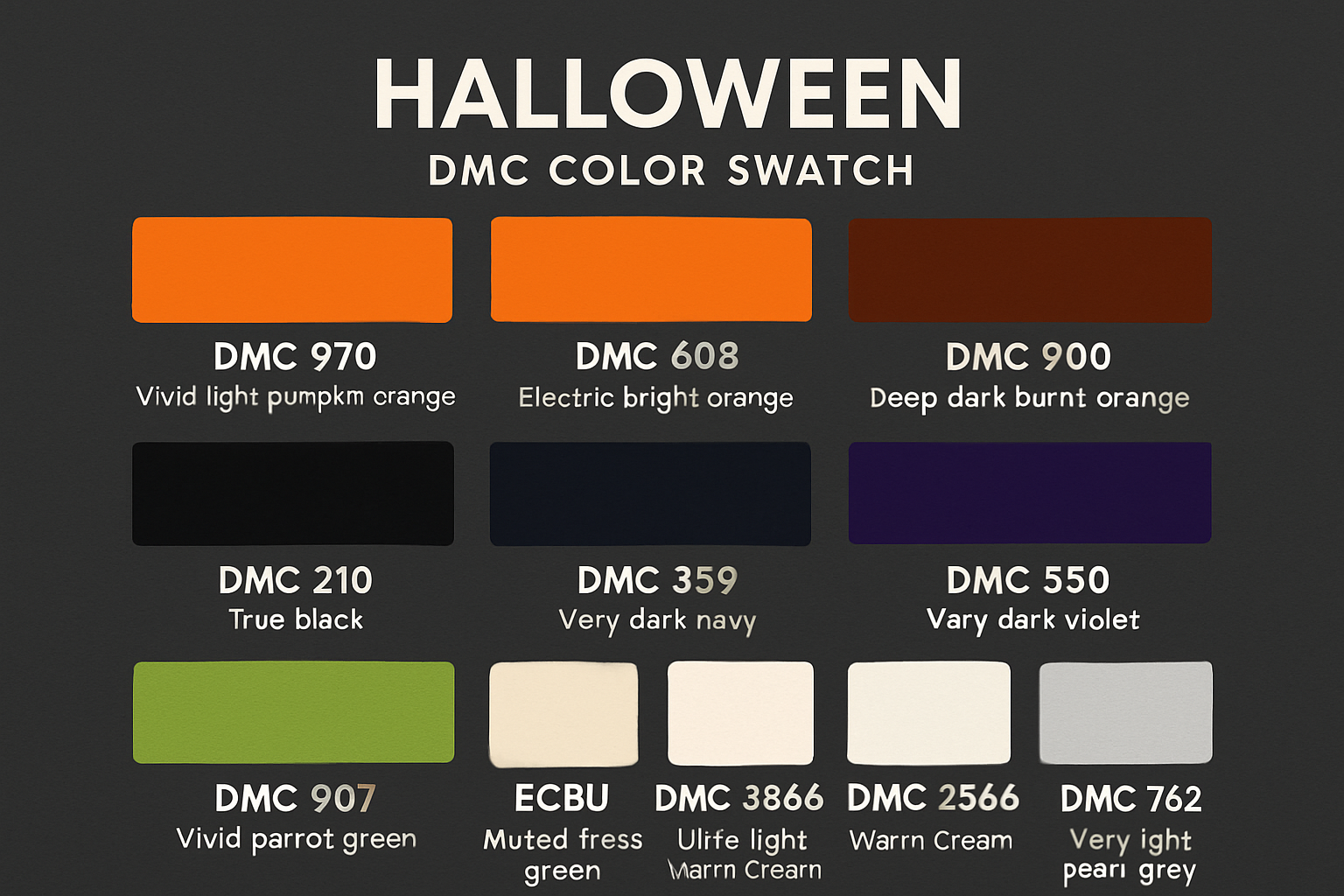
The orange spine: DMC 970 → 608 → 900
For Halloween, the orange family shifts brighter and more vivid than the autumn range. DMC 970 (Light Pumpkin) is the lit jack-o-lantern interior. DMC 608 (Bright Orange) is a vivid, saturated jack-o-lantern face in full light. DMC 900 (Dark Burnt Orange) is the deep, shadowed edge. These are bolder and cooler-toned than the warm harvest oranges (720, 721) ; they read as electric rather than cozy.
True black and near-black: DMC 310, 3371, 939
DMC 310 (Black) is the anchor shade for Halloween, used where autumn palette avoids it. Cat silhouettes, bat wings, spider bodies, the background dark in a graphic design, witch hat outlines — all call for 310's uncompromising quality. DMC 3371 (Black Brown) softens the contrast in fur or shadow areas where full black would be too harsh. DMC 939 (Very Dark Navy Blue) is the shade to reach for in night-sky areas; black reads as flat against dark fabric, but 939 gives the sky depth and color.
The purple range: DMC 550 → 552 → 553 → 3837
Halloween is the season where purple earns its place in cross stitch. DMC 550 (Very Dark Violet) is deep and moody: shadow areas, dark cloaks, night-adjacent backgrounds. 552 and 553 are mid-toned purples good for atmospheric gradient areas. DMC 3837 (Ultra Dark Lavender) is rich and jewel-like, good for potion bottles, witch robes, and the cooler parts of a night sky.
Poison and slime: DMC 907 → 905 → 3819
Not every Halloween piece needs them, but for potions, cauldrons, slime, and poisonous botanical motifs, DMC 907 (Light Parrot Green) and 905 (Dark Parrot Green) are the vivid, slightly unnatural greens that read as genuinely uncanny. DMC 3819 (Light Moss Green) is more muted, useful for "witchy herbs" rather than cartoon slime.
Ghost and bone: ECRU, 3866, 415, 762
Ghost shapes need thread that reads as pale and slightly off-white rather than clean bright white (Blanc). ECRU and DMC 3866 (Ultra Very Light Mocha Brown) have just enough warmth to read as candlelit. DMC 415 (Pearl Grey) and 762 (Very Light Pearl Grey) give the pale mid-tone layers that give a ghost or skeleton depth.
Dark Fabric: When Your Background Does the Work
Most cross stitch instruction defaults to cream or white Aida. Halloween is the one season where that default is worth questioning.
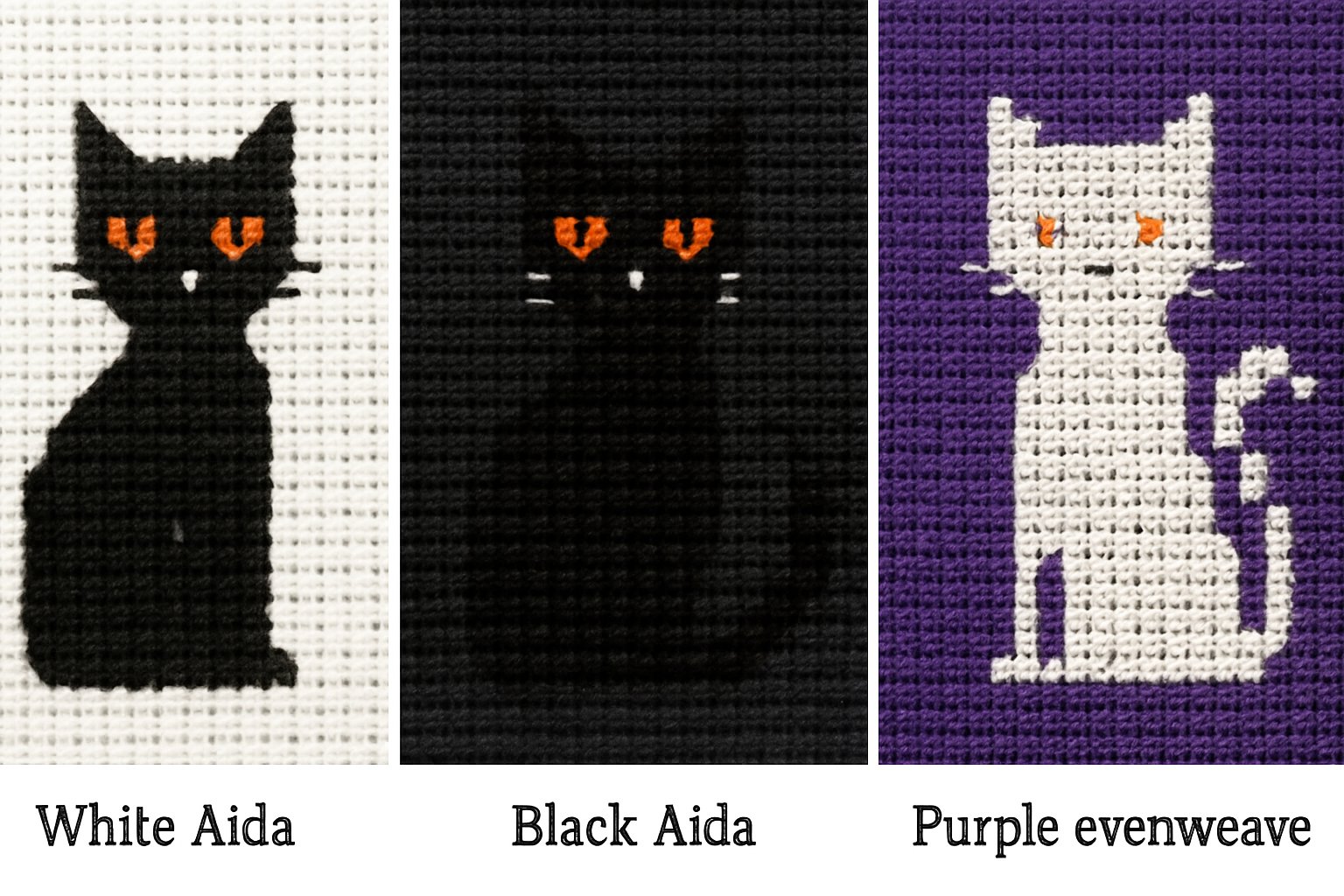
Black Aida (14-count or 18-count) eliminates the need to stitch any background. A silhouette design (a black cat sitting in a full orange moon, a haunted house against a dark sky, a witch on a broomstick) can be stitched entirely in the foreground colors, with the fabric itself providing the darkness. This dramatically reduces stitch count, speeds completion, and produces a piece with a matted, professional look that pale-background designs rarely achieve. The limitation: standard cross stitch pattern charts are designed for pale backgrounds, so dark-fabric projects either need patterns explicitly designed for the format or require removing background stitches manually in the digital canvas.
Purple evenweave or Aida (28-count) is the witchy aesthetic's secret weapon. A 28-count evenweave in deep purple with DMC ghost-whites and silver metallic produces a piece that looks like it was found in a Victorian apothecary drawer. The finer count also suits the witchy detail-work (botanical illustrations, moon phases) that this aesthetic tends toward.
Colored Aida in harvest tones (rust, terracotta, pumpkin) gives a warm Halloween feel without full dark contrast. A black cat or bat motif on rust-orange Aida creates a warm vintage look closer to antique quilting than gothic drama.
When generating a pattern from a photo for use on dark fabric, remember that the converter assumes a pale background by default. Either use a photo with a transparent background (PNG), or plan to manually remove background stitches in the digital canvas after generating, replacing them with the dark fabric color rather than leaving them as pattern squares.
Halloween Project Ideas Worth Starting in September
Halloween cross stitch earns its own planning consideration because the display window is short (essentially October), which creates useful constraints.
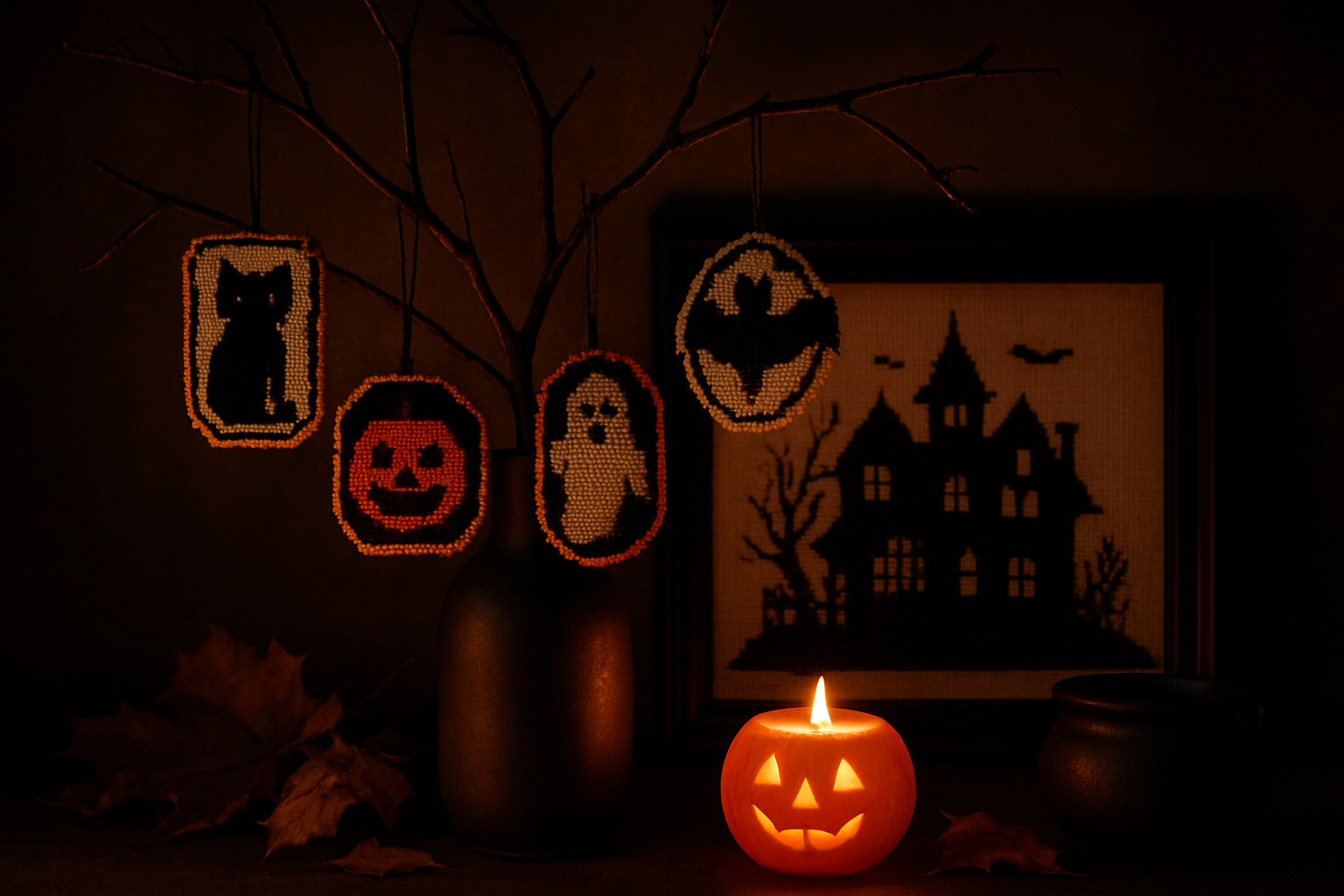
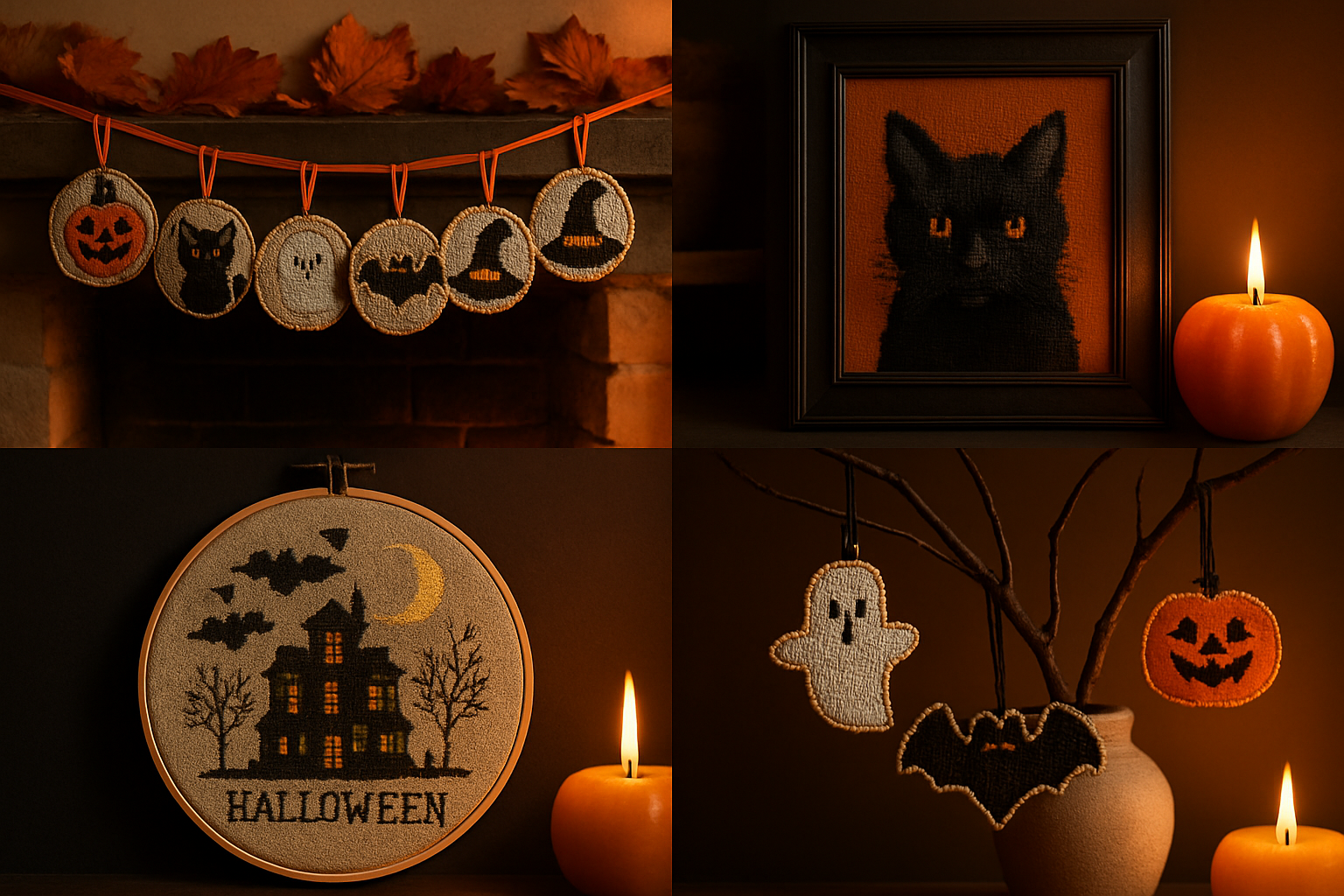
A garland of mini ornaments is the Halloween community's most-loved format. Six to eight small designs (50×50 stitches each, 5–8 hours apiece), backed in felt and strung on ribbon or twine, hang as a garland over a mantel or across a window. The subjects nearly choose themselves: one jack-o-lantern, one black cat, one ghost, one bat, one witch hat, one full moon. Each can be made from a simple motif or, for the jack-o-lantern and cat, from a photo conversion. Start in September with one ornament a week and you'll have a finished garland by late October.
A framed Halloween portrait (your specific cat, your dog in their costume, your carved pumpkin) is the more ambitious option. A 100×100-stitch photo pattern at 14-count finishes at around 7 inches square, perfectly suited to an 8×10 frame with a dark mat. It comes out every year. It gets better every time it comes out.
A quick Halloween sampler (haunted house, bats, a few stock motifs) in the 80×80 to 100×100 range gives satisfying Halloween-season work without the personal investment of a photo pattern. Many free and low-cost chart options exist online, and most use fewer than 10 colors, fast and low-stress alongside other ongoing projects.
A needlepoint Halloween ornament in wool on 18-mesh canvas is a different kind of satisfying; the dense coverage makes it feel substantial and heirloom-quality. A 3-inch ornament at 18-mesh takes about 8–10 hours. A small collection of them on a bare dark branch is one of the best possible Halloween home accents.
Displaying Halloween Cross Stitch: It Deserves Its Own Season
Halloween cross stitch has a display habit that separates it from the rest of the seasonal calendar: it comes out on October 1st and gets packed away on November 1st with more ceremony than almost any other seasonal decor in the house. That one-month window is part of what makes it feel special.
An ornament tree (a dark or bare branch in a weighted vase) hung with four to six finished Halloween ornaments is the format most commonly shared in needlework communities. It's genuinely beautiful, takes up a small footprint on a side table, and doubles as a repository for new pieces each year. Start with three ornaments this year, add one or two each year, and within five years you have a collection.
A hoop wall cluster (three to five finished pieces in different-sized hoops hung as a loose grouping) suits a hallway or entry wall where you want Halloween to be felt immediately on entering. It also shows off variety in subject matter: a pet portrait, a witchy motif, and a pumpkin in adjacent hoops creates a personal collection feel.
A mantel or shelf arrangement mixing finished framed cross stitch with actual autumn and Halloween objects (candles, small pumpkins, dried leaves, a skull or two) gives a curated display where the stitched pieces look like they were always meant to be part of the decoration. They were.
October is short. Pick the subject that means something to you (your cat, your pumpkin, a scene from last year's porch), generate a preview, and start stitching. The piece will be on the wall before the leaves finish falling.
Try it with your own photo
Upload a photo and see your counted cross stitch pattern preview — free, before you pay anything.
Try the free pattern previewA little autumn gift for reading this far
Start your fall pattern free, then use one of these codes at checkout when you unlock the digital canvas.
Codes valid through the end of autumn 2026.